JOHN STEZAKER & THE MIRROR OF
MAXIMILIAN I, EMPEROR OF MEXICO
Private view
11th September 2026, 5-9pm
John Stezaker on:
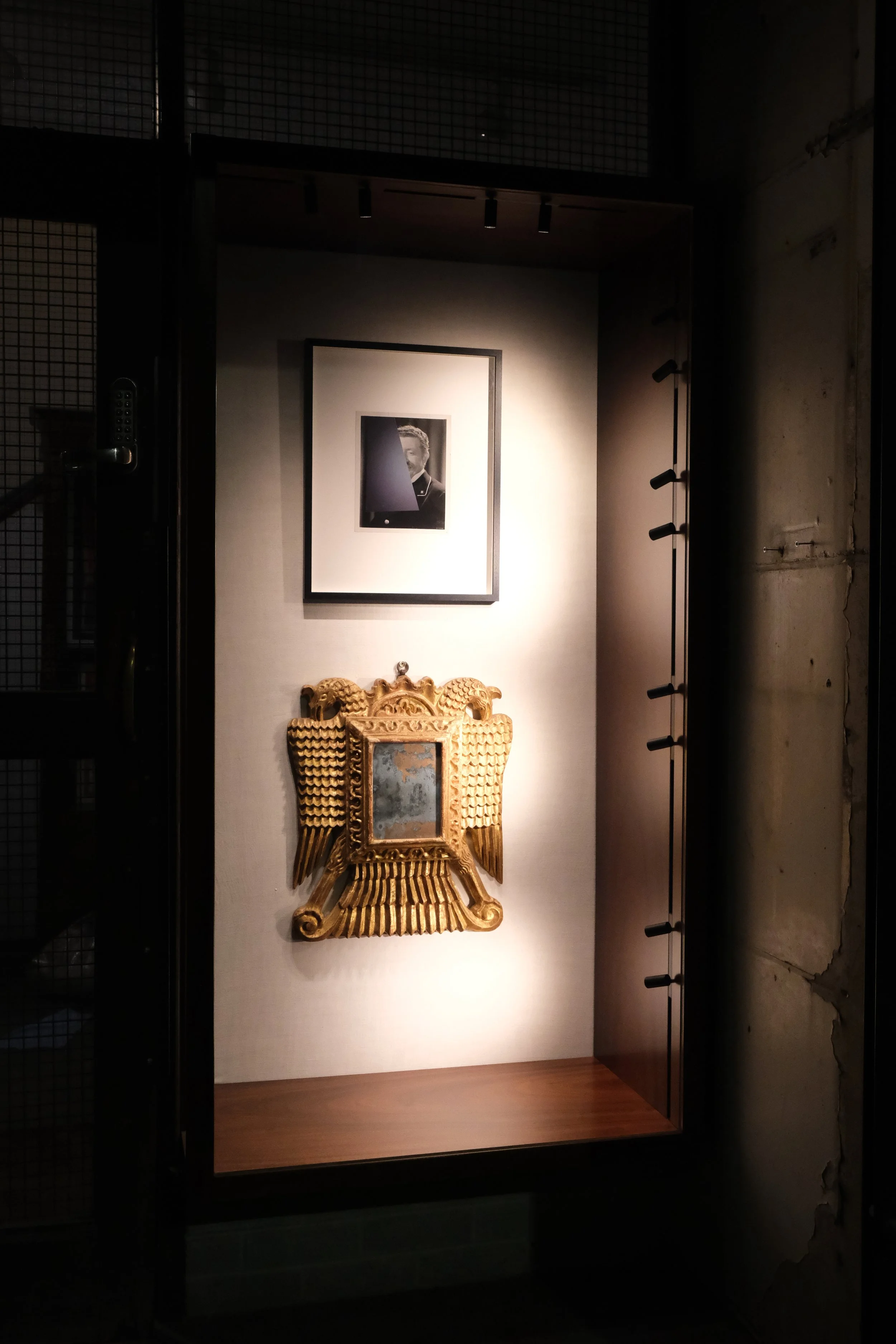
A mirror, c.1850. Formerly belonging to Emperor Maximilian I of Mexico
In all but one version of Manet’s The Execution of Emperor Maximilian, the emperor, in the moment of his execution by firing squad, seen through a cloud of gun smoke, seems already to belong to another world. As spectral grey as a photograph, he has already become a fixed ancestral image. He seems already dead. Manet might have been inspired in this distant image of the emperor by Velazquez’s Las Meninas, which is similarly punctuated by a remote image of sovereign power (whose portrait the painter purports to be painting). The king and queen appear in a remote mirror as similar silhouette abstractions of the standard poses of royal or imperial portraiture. The mirror, as a piece of furniture, punctuates the everyday domestic space as the presence of the otherness of the image. Mediating that division between reality and image, mirror frames reflect different ways in which the image is integrated into the everyday world at different times and in different places. One can imagine how Maximilian’s now nearly opaque occluded mirror, framed by the excessive decorative motifs of empire furniture once framed the fragile visage seen through the haze of gunsmoke.
The one version of this painting in which the imperial silhouette does not appear at all is in the now fragmented full-scale painting, which Manet originally intended for exhibition in the Salon. The emperor has almost disappeared around the edge of one of the canvas fragments, into which the painting was subdivided after Manet’s death for more domestic-sized paintings for sale by his heirs. All of these were later purchased by Degas, who assembled them as a collage in his studio, with gaps for the missing sections. This fascinating collage/painting now hangs in the National Gallery. The fragmentary reconstitution of the painting, banned in Manet’s day, however, virtually omits the figure of the emperor altogether, arguably completing a process of his marginalisation in the series of paintings, a redirecting of attention from the figure of power to the image of the everyman. This decentring tendency is reflective exactly of the rise of social democracy, which resulted in the execution of the emperor.
Maximilian’s mirror, dwarfed by its enormous imperial frame seems a perfect metaphor for the emperor, deprived first of power and then of life, a strangely marginal figure in history.